
Traffic Warrants in Livingston County
Traffic cases in Livingston County land in the 53rd District Court, chosen by where the offense happened, while civil infractions sit on their own ticket docket. A warrant only enters when a driver skips a scheduled date or leaves a court order unmet; the citation alone never triggers one. The court's tickets page spells out payment and hearing routes, and the criminal matters page covers the warrant side. Drunk driving stands apart. The court treats it as a criminal offense rather than a traffic offense, so those cases follow a different track from day one. Note: what follows here is about court records and court resolution, while driving records, insurance, and license points belong to the state.
Livingston County Traffic Warrant Payments
The payment rules are posted plainly. Online, the court takes Visa or Mastercard. The counter takes Visa, Mastercard, Discover, check, money order, or cash in person. Mail requires a US-drawn check or US money order payable to the 53rd District Court. No credit cards by phone, and bond and restitution stay cash or money order only in Livingston County.
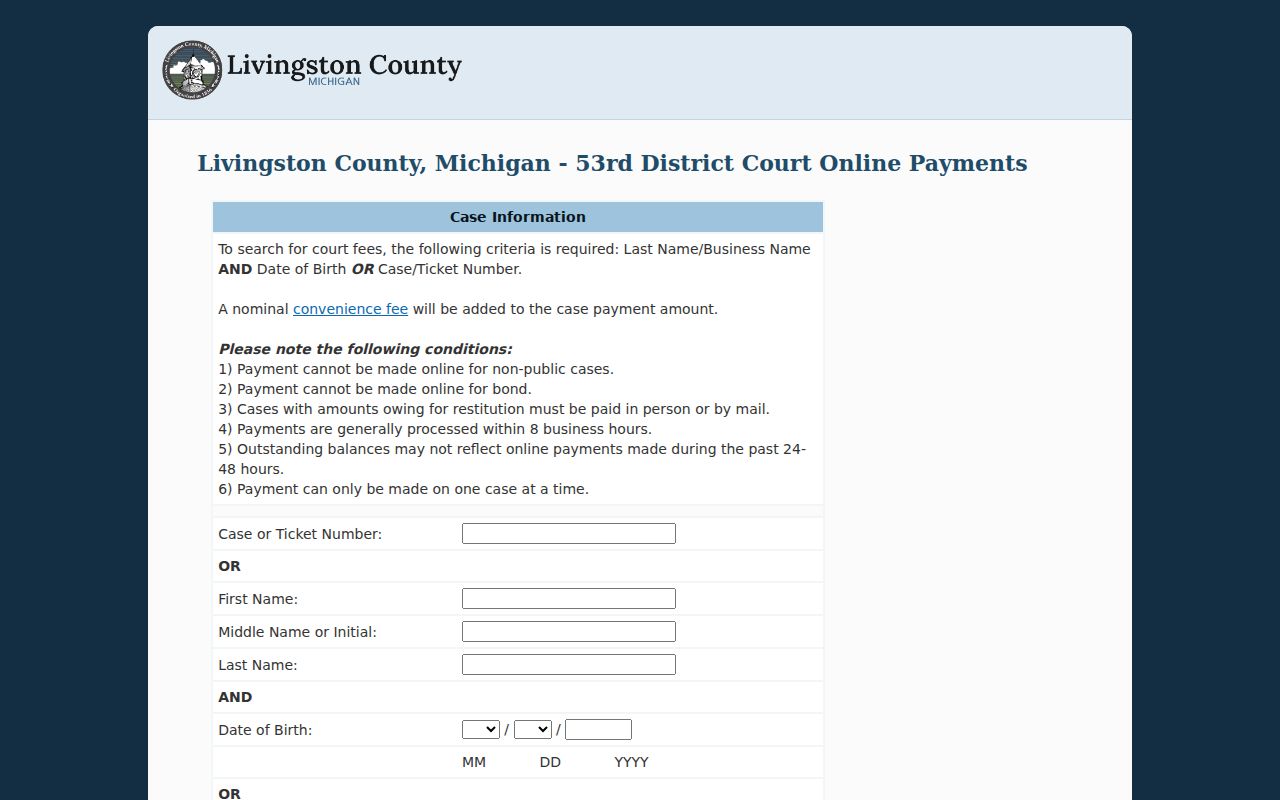
The Livingston County portal is a payment and account tool. It shows what a case owes, but it does not confirm whether a warrant is active.
How to Check for a Traffic Warrant
Start with the citation itself. The ticket names the court, and that court holds the record that answers the warrant question in Livingston County. The open-warrants document and the clerk's phone line are the two public routes that confirm status.
- Find the case or ticket number on the citation or on any notice the court mailed.
- Search the District Court open warrants document for the name.
- Look up the case in the payment portal to see the current balance and case status.
- Call the court at (517) 548-1000 and ask directly whether a warrant is active on the case.
- Check MiCOURT for a public register entry if you need the docket history.
Traffic Warrant Types in Livingston County
Three categories move through this Livingston County court, and they carry different weight. A civil infraction is not a crime. A traffic misdemeanor is. Drunk driving gets charged as a criminal offense, and the court says so directly. Miss a civil-infraction date and you risk court action plus a separate license consequence. Miss a misdemeanor date and you risk a bench warrant with custody attached. The court file states which one applies; the public list does not. One more caution applies here. A fine or cost amount is never a bond amount, and the court's approximate, changeable fine schedule does not set warrant terms.
What a Traffic Warrant Shows
In the Livingston County public document, a traffic warrant entry looks like any other. You get three fields. No explanation comes with them.
| Case or Ticket Number | An identifier such as 20XX-XXXXXX-A, mixing letters and numbers with a suffix the court does not explain publicly. |
|---|---|
| Name | The name as printed in the document, surname first. |
| Birth Year | Four digits, used only to narrow a common name. |
| What It Omits | Whether the matter is a civil infraction or a misdemeanor, the charge, the fine, the bond, and the service status. |
| Where to Confirm | The 53rd District Court clerk, by phone or at the counter. |
That is why your citation matters in Livingston County. The paperwork in hand tells you more than the public list ever will.
Livingston County Traffic Warrant Hearings
Some civil infractions can be resolved without a formal appearance. The court's tickets page says an informal hearing can be requested by phone, and only if the civil-infraction ticket is less than 10 days old. Confirm the current form and process with the court before relying on that route. A formal hearing is a different proceeding, and a Livingston County traffic misdemeanor runs on the criminal docket instead. Missing a hearing and missing a payment bring different consequences. Neither is undone by paying a balance after the date has passed. If the court date already slipped by, ask the clerk which track the case sits on before you file anything or send money.
Paying or Lifting a Traffic Warrant
Paying a balance does not recall a warrant unless the court says so. The portal handles money; the judge handles warrants in Livingston County. Keep the receipt as proof of payment, then call the court to confirm status.
Caution: A receipt shows that money was paid, not that a warrant was withdrawn. Ask the clerk to confirm the warrant status in writing or on the record.
Where a warrant is open, the paths are few. A court appearance, a payment arrangement the court allows, or a motion handled by a lawyer. The Livingston County court decides which one fits the case.
When a Livingston County Warrant Payment Lags
The portal itself warns about delays. Online balances can lag recent transactions by 24 to 48 hours, it handles one case at a time, and nonpublic cases and online bond payments are excluded. Typical processing runs about eight business hours. Keep the receipt and the confirmation number. Then call the court if the balance still looks wrong after two business days. A stale figure is a display problem, not an erased payment. If Livingston County issued the warrant because a payment posted late, ask the clerk what it takes to clear the warrant now. That conversation belongs with the clerk, never the payment vendor.
Resolving a Livingston County Traffic Warrant
Start at the District Court counter. The court takes in-person appearances on civil-infraction warrant matters Monday through Friday from 9:00 to 9:30 a.m., right alongside its felony and misdemeanor warrant matters. Hours can shift. Confirm the schedule, plus any holiday closures, before you head out. Bring the citation, the case number if you have it, and any payment receipt. The counter sits inside the Judicial Center at 204 S. Highlander Way, Suite 1, Howell, and the Livingston County clerk there can tell you what the judge needs next. One visit settles little on its own. The court may set a hearing, an arraignment, a payment plan, or a new date, so a Livingston County traffic warrant can easily take more than one trip.
Traffic Warrant vs FTA and License Holds
Three outcomes get tangled in traffic cases. A warrant, a failure to appear, and a license hold each belong to a different system, and in Livingston County, mixing them up means clearing one problem while believing you cleared all three.
| Outcome | Who Handles It | How It Ends |
|---|---|---|
| Bench warrant | The court that set the date | An appearance, a recall, or service |
| Failure to answer | The court and the Secretary of State | A mailed notice, then compliance or suspension |
| License suspension | The Secretary of State | Reinstatement after the state's requirements are met |
MCL 257.321a lays out the failure-to-answer process. It generally starts 28 or more days after a missed response and continues with a mailed notice. If the failure keeps going, a license suspension can follow, so a Livingston County driver facing this track should treat it as a compliance matter, not a warrant.